
by John Gillett
Curator Emeritus, Botany Division, Canadian Museum of Nature
[Editor’s note: As Gillett points out below, Aster species are difficult to differentiate; furthermore. the nomenclature of this group has changed substantially since he prepared this material. To be accurate, we have added the latest names, as found in Canadensys’ Database of Vascular Plants of Canada (VASCAN), in square brackets after the names Gillett used.]
My objective in presenting this series of articles on various plant groups of this region is to try to explain how to identify them in the simplest way possible without recourse to the technical words usually associated with systematic botany. This is not always possible because technical jargon is designed to be precise and concise, an attribute difficult to assign to common English.
I believe this objective is feasible because of the nature of floras. It is evident that it is easier to identify the lower number of species to be found in a smaller area as opposed to the larger number in a larger area. For example. Gray’s Manual, which covers all of eastern continental USA and eastern Canada, contains a key to 67 species of Aster, Semple and Heard’s treatment of the Asters of Ontario contains 32 species. In the Ottawa-Hull region we have only 14 species. Therefore, it should be easier to separate these on gross characteristics rather than to resort to the use of more technical characteristics that are difficult to discern. This ideal may be feasible for the more easily separated species, but is not always possible for the separation of very similar species. Unfortunately we have a couple of these here.
Outside of the gaudy introduced Purple Loosestrife which fills our fields and wetlands and blooms in August, the goldenrods and the asters or Michaelmas Daisies are among the more showy native flowers to be found in this region. The goldenrods we covered in an earlier article (Gillett 1991). The number of Aster species (14) is the same as for the goldenrods. The scientific name for the genus is the same as the English name so it is very easy to remember. It should not be confused with the “Aster” of our cultivated gardens which is really the China Aster, Callistephiis chinensis Nees, an annual from China and Japan, which appears in many colours excepting yellow.
Both asters and goldenrods are members of the family Asteraceae (alternate name Compositae, i.e., if you don’t like the name Asteraceae, then you can use Compositae), characterized by flowers borne in heads, as in the daisy (Chrysanthemum). Each head is composed of tubular disc flowers (yellow) in the central portion and usually, but not always, is surrounded on the outside with flowers having flat strap-shaped ligulate flowers, the ray flowers to which we usually ascribe the flower’s colour. The whole group of flowers is enclosed in a ring or involucre of green bracts (called phyllaries). This arrangement of flowers constitutes a very efficient pollination method because the head of flowers acts collectively like a single flower. The insect pollinator then is provided with a landing platform and is able to visit many flowers at the same time. Thus the arrangement works both ways; the insect obtains more pollen or nectar with less effort and more flowers are pollinated by the insect.
Aster ptarmicoides (Nees) T. & G., the Upland White Aster [Aster Faux-ptarmica], which appears on my checklist of Ottawa District plants (Gillett and White 1978), is now (Gillett 1991) included among the goldenrods as Solidago ptarmicoides (Nees) Boivin; so you see it is not always easy to tell a goldenrod from an aster!
Taxonomically the genus Aster is considered to be quite difficult. One of the problems is to settle on borders for the genus; another is the recognition of certain species. When the genus is studied over its entire range, there are problems distinguishing some species from members of the genera Baccharis or Vemonia that, fortunately for us, do not occur in this area. We do, however, have a couple of difficult-to-distinguish species.
Key to the asters of the Ottawa-Hull region
The 14 species of Aster that occur here can be keyed out as follows:
l. At least the lower leaves cordate (heart-shaped) or rounded at the base and with obvious petioles (stalks).
Go to 2
Leaves not cordate and not always with petioles.
Go to 4
2. Inflorescence usually forming a corymb, i.e., the lower flower stalks are longer than the upper so the entire flower cluster is more or less flat on top (as in illustration of A. umbellatus); inflorescence branches glandular and with broad, almost leafy, firm bracts (these are the bracts on the inflorescence stalks not those surrounding the flower head which are called phyllaries). Flowers violet or lavender. Aster macrophyllus
Inflorescence elongate, forming a panicle (a loosely branched compound flower head); inflorescence branches not glandular and with narrow, numerous, small bracts.
Go to 3
3. Leaf petioles without wings; inflorescence often with more than 100 heads. Flowers blue violet to pink.
A. cordifolius
Leaf petioles distinctly winged; inflorescence usually with less than 50 heads. Flowers blue or violet.
A. ciliolatus
4. Either the involucral bracts (phyllaries), or even the seeds, distinctly glandular, sometimes the rest of the plant as well. To see this you are going to need the 10× lens that I suggested you buy in an earlier article
Go to 5
Plants not glandular
Go to 7
5. Leaves strongly clasping at the base. Flowers dark purple to pink or white
A. novae-angliae
Leaves tapered, not clasping at the base
Go to 6
6. Leaves 2–6 cm wide, with prominent teeth, long slender tips and forming apparent whorls due to shortening of the stem nodes; 10 to 20 leaves below the inflorescence. Flowers white to faintly pinkish
A. acuminatus
Leaves linear-lanceolate, 0.5 to 1.2 cm wide, without teeth; 25–40 leaves below the inflorescence. Flowers pink or lilac-purple
A. nemoralis
7. Leaves clasping at the base. Flowers pale mauve to dark purple or white
A. puniceus
Leaves not at all or scarcely clasping
Go to 8
8. Annuals with the ray flowers shorter than the mature pappus. (The pappus is a cluster of hairs found on the tip of the seed or achene in Asteraceae). In this species the pappus is visible at any stage because of its abundance and length
A. brachyactis
Perennials with long well-developed ray flowers longer than the mature pappus
Go to 9
9. Flowers with white rays borne in a somewhat flat-topped corymb; plants up to 2 m tall, often forming dense stands; in marshy areas
A. umbellatus
Smaller plants with flower heads forming a more elongate inflorescence; plants not in marshy areas
Go to 10
10. Flower heads usually on a simple raceme (unbranched pedicels for each flower head); heads 2.0 to 2.5 cm wide, purple or white
A. borealis
Heads smaller, borne in obvious panicles (with branched pedicels)
Go to 11
11. Heads very numerous, often borne on one side of the branches; leaves extremely numerous and narrow, about 1 cm long and 0.1 to 0.2 cm wide, spine tipped, (as are the involucral bracts); ray flowers white
A. ericoides
Heads fewer, not borne on one side of the branches; leaves fewer, larger, averaging 10 cm long and about 1 cm wide; neither leaves nor involucral bracts spine-tipped; ray flowers white to pink
Go to 12
You may not want to go any further with this key as the next two species A. lanceolatus and A. lateriflorus are considered by Semple and Brammall (1982) to be able to hybridize. Probably A. ontarionis is a product of this hybridization. In other words, these three species are not clearly separable and are only recognizable by a combination of characteristics rather than any single character. However, I have included the obvious “eye-ball” characteristics. There are others using differences in the disc flowers which are difficult to express here.
12. Principle stem leaves 8 to 15 cm long, 0.3 to 0.4 cm wide, lanceolate to linear, tapering at both ends, nearly clasping at the base, glabrous below (without hairs), but with fine hairs along the margins; plants forming colonies by extensive underground stems or rhizomes
A. lanceolatus
Principle stem leaves wider than 0.5 cm near the centre
Go to 13
13. Leaves generally hairy below over the surface; plants with creeping rhizomes; inflorescence usually elongate; rays white to occasionally pink
A. ontarionis
Leaves hairy only along the midrib; plants without creeping rhizomes; inflorescence may be elongate also or it may be more ovate; rays white
A. lateriflorus
These last two species are superficially almost identical. In order to distinguish them you must use that hand lens. The creeping rhizomes are rarely seen on herbarium specimens. The leaf pubescence is a fairly good character. Aster ontarionis has short, rough, (scabrous) hairs between the veins and longer hairs on the central vein, but Semple and Brammall indicate that the leaves could be quite glabrous! The ray of flowers are definitely shorter in A. ontarionis than in A. lateriflorus, and both may turn purplish with age.
Notes on individual species
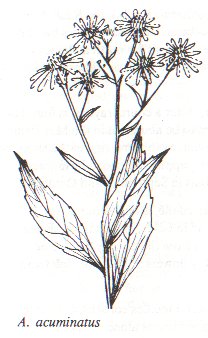 Aster acuminatus Michx. [now Oclemena acuminata]
Whorled Wood Aster, Whorled Aster, Mountain Aster
Aster acuminé
Found in Gatineau Park and the Leitrim wetlands. It is primarily an eastern plant found throughout the Maritimes but occurs throughout southern and eastern Ontario in woods. The ray flowers are white to faintly pinkish. Whorled Wood Aster is, as the name implies, a woodland species. Flowering is from August to October. [photos of Aster acuminatus]
 Aster borealis (Torr. & Gray) Prov. [now Symphyotrichum boreale]
Rush aster
Aster boréale
Found in wet places such as bogs, fens and marshes but has been found on limestone pavements. I have seen it as far north as James Bay but it extends right across Canada. Ray flowers are violet or white and bloom from July to September. [photos of Symphyotrichum boreale]
Aster brachyactis Blake [now Symphyotrichum ciliatum]
Short-rayed aster, Rayless Annual Aster
Aster à courts rayons
 Found in sandy or gravelly disturbed ground. It seems to be abundant in the Mer Bleue area on the dry ridge. Dried herbarium specimens show no sign of the short ray flowers but have clumps of somewhat silvery pappus subtended by tapered strap-like green involucral bracts. This blooms in September and October. [photos of Symphyotrichum ciliatum]
 Aster ciliolatus Lindl. [now Symphyotrichum ciliolatum]
Ciliolate aster, Fringed Blue Aster
Aster ciliolé
One of our most abundant and beautiful fall wildflowers found in fields, in woods, on slopes and along roadsides. It is easily distinguished from the equally handsome A. cordifolius by the winged leaf petioles. Ray flowers are blue or violet and blooming is from August to October. [photos of Symphyotrichum ciliolatum]
 Aster cordifolius L [now Symphyotrichum cordifolium]
Heart-leaved Aster
Aster à feuilles cordées
Of course, lacks the winged leaf petioles; the heart-shaped leaves alone are not always enough to distinguish this species from A. ciliolatus. Common at the edge of woods and in thickets, along river banks. Flowers blue or violet and bloom from July to October. [photos of Symphyotrichum cordifolium]
 Aster ericoides L. (syn. Virgulus ericoides (L.) Reveal & Keener) [now Symphyotrichum ericoides]
Heath Aster
Aster éricoïde
Not overly common in our area. I have seen it in the eastern part of Ottawa and it is known from Burritt’s Rapids, North Gower and Prospect. This aster is easily recognized by the numerous small bract-like leaves. It is found in pastures, along roadsides and in dry meadows. Flowers are white and bloom from August until October. [photos of Symphyotrichum ericoides]
 Aster lanceolatus (syn. A. simplex Willd., A. paniculatus Lam.) [now Symphyotrichum lanceolatum]
Panicled Aster
Aster à feuilles lanceolée
This plant occurs throughout Ontario and is abundant in this district. It is found in open fields and ditches, alvars, dry or moist meadows. The white flowers bloom from August to early October. [photos of Aster lanceolatus]
 Aster lateriflorus (L.) Britt. now Symphyotrichum lateriflorus]
Calico Aster
Aster latériflore
Common in fields, edges of woods, river banks, rocky shores, alvars, and cedar swamps. The white flowers bloom from August until October. [photos of Symphyotrichum lateriflorus]
 Aster macrophyllus (L.) Cass. [now Eurybia macrophylla]
Large-leaved Aster
Pétouane
This is found in woods, in thickets, rock outcrops, and alvars. Often you will find large colonies of leaves without flowering stalks. The lilac-tinged ray flowers will only occur at intervals but the leaves are distinctive. It blooms from August until October. [photos of Aster macrophyllus]
 Aster nemoralis Ait. [now Oclemena nemoralis]
Bog Aster
Aster des bois
As the name implies, Bog Aster is restricted to acidic bogs. Semple and Heard (1987) indicated that the species is found in the Algoma Highlands and Algonquin Highlands of Ontario. In our area the Bog Aster is found in bogs in Gatineau Park. Flowers are pink or lilac-purple and bloom from July to September. [photos of Oclemena nemoralis]
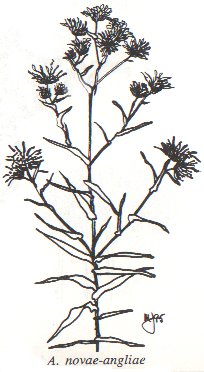 Aster novae-angliae (syn. Virgulus novae-angliae (L.) Reveal & Keener) [now Symphyotrichum novae-angliae]
New England Aster, Michaelmas Daisy
Aster de la Nouvelle-Angleterre
There is considerable variation in flower colour in this species, ranging from dark purple to pink or white. Some have been given cultivar names. New England Aster is common in fields throughout the region. I have transplanted a few plants to my garden which were rescued from housing developments. These asters blend well with my cultivated plants, forming a tall backdrop to the flower beds. Flowering is from August to October. [photos of Aster novae-angliae]
 Aster ontarionis Wieg. [now Symphyotrichum ontarionis]
Ontario Aster
Aster d’Ontario
This species is listed among our rare plants of Ontario. Habitats include river banks, swamps, rocky ridges, sandy fields and roadsides. Flowers are usually white but may be pink, and blooming is from August until October. [photos of Symphyotrichum ontarionis]
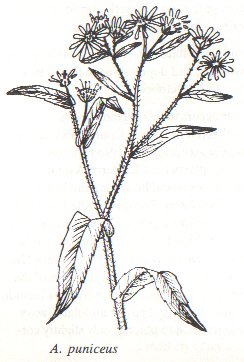 Aster puniceus L. [now Symphyotrichum puniceum]
Purple-stemmed Aster, Pitnagen, Teaflower
Aster ponceau
This is a species of swamps, wet cedar woods, along streams and river banks. Flower colour is extremely variable, from pale mauve to dark purple or white. This is a very handsome species, flowering from August to October. [photos of Symphyotrichum puniceum]
 Aster umbellatus Mill. [now Doellingeria umbellata]
Flat-topped White Aster, Umbellate Aster
Aster à ombelles
A common species of bogs, wet places, swamps, and depressions in fields. Ray flowers are white. Flowering is from August to October. [photos of Aster umbellatus]
As in my previous articles the drawings are by Sally Gadd done many years ago for my Gatineau Park Flora (unpublished). Because this article covers a larger area and includes additional habitats, four more drawings by Marcel Jomphe were added.
There is a possibility that one other Aster occurs in this region. This is A. oolentangiensis Riddell. It has been collected in Lanark County, Pakenham Township and has been reported from near Arnprior, and also reported, but not confirmed, from the talus slopes of the quarry near Lapierre Avenue, Ottawa. In the key presented here, this species would be among the heart-shaped leaf group of A. ciliolatus and A. cordifolius. The quarry site has a number of native species on the top, such as Symphoricarpos, and since originally a number of alvars existed there, a common habitat for A. oolentangiensis, it is possible that it survives man’s destructive activities. It is mostly a southern Ontario species and was formerly known as A. azureus. Due to application of the rules of priority this name had to be changed. Distinguishing characters include the blue flowers and leaves which are entire (not toothed) or undulate (wavy margins) and the leaf blades are ovate-lanceolate to oblong, only slightly cordate at the base.
There is one point that I should like to emphasize. A number of native plant species have great horticultural potential. As I have already mentioned, I transplanted Aster novae-angliae into my garden. But many of the goldenrods would also enhance the garden. I have not tried them yet but intend to do so (I’ll check for new housing developments!). Native plants tend to make themselves at home and can often spread more than is desirable. A little careful weeding will take care of this problem.
References
- Gillett, John M. 1991. Goldenrods. Trail & Landscape 25(4): 114-121.
- Gillett, John M. and David J. White. 1978. Checklist of vascular plants of the Ottawa-Hull region, Canada/Liste des plantes vasculaires de la région d’Ottawa-Hull, Canada. 155 pp. + map.
- Semple, John C. and Ronald A. Brammall. 1982. Wild Aster lanceolatus × lateriflorus hybrids in Ontario and comments on the origin of A. ontarionis (Compositae: Astereae). Can J Bot 60: 1895-1906.
- Semple, John C. and Stephen B. Heard. 1987. The Asters of Ontario: Aster L. and virugulus Raf. (Compositae: Astereae). University of Waterloo Biology Series 30. 88 pp.
- Muma, Walter. 2017. “Asters Group” in Ontario Wildflowers.